
If you’ve spent enough time inside offensive security – whether embedded in a red team or leading a security organization – one reality becomes obvious: most companies aren’t losing ground because they lack penetration testing.
In fact, pentesting remains one of the most universally adopted assurance mechanisms. Most of mid-to-large enterprises run multiple pentests at least once per year, and highly regulated industries run them even more frequently.
The problem is that the traditional, once-in-a-year model runs out of sync with the operational tempo of modern risk.
Modern infrastructure is an ever-changing system of ephemeral workloads, microservices, IaC-driven deployments, and third-party integrations. Environments can shift materially within hours, which creates a tempo mismatch between how organizations operate or grow and how pentesting is delivered.
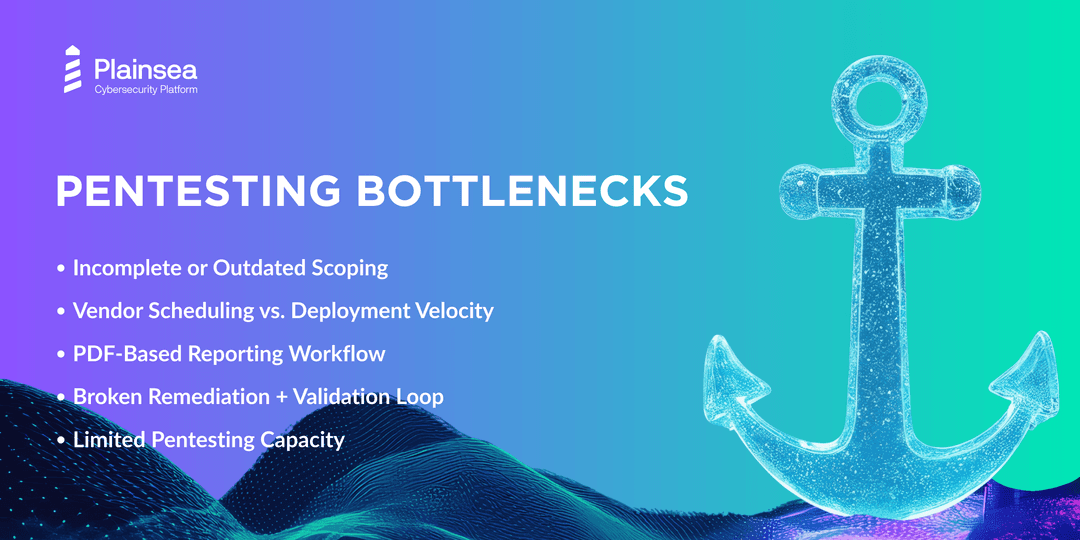
In this article, we break down the 5 pentesting-related operational bottlenecks that consistently slow organizations down, regardless of their size or maturity. These patterns repeat across industries, geographies, and verticals. If you’re a security leader, you will recognize at least three of them immediately – and probably feel all five.
1. Scoping in the Dark
Every pentest kickoff begins with a deceptively simple question: “What exactly are we testing?”
It's often assumed that this is an easy question. In practice, it rarely is and industry data shows just how big the blind spot is.
Research by Enterprise Strategy Group found that nearly seven in ten organizations (69%) have experienced at least one cyberattack that started through an unknown or poorly managed internet-facing asset.
As a result, the pentest reflects the documented environment, not the real one.
This incomplete knowledge leads to incomplete tests. And what testers don’t know exists, they can’t evaluate.
2. Vendor Calendars vs Change Velocity Misalignement
This bottleneck is the one engineering leaders complain about the most:
“We want this tested before launch.” “Our vendor can start in five weeks.”
By the time that window opens, the code has already shipped, users are relying on the new features, and your attack surface has changed multiple times.
SANS’ State of Application Security survey found that 43% of organizations push changes to their applications weekly, daily or even continuously, while 24% security-test their applications only once a year or less and 10% aren’t testing their business-critical apps at all. Internal penetration testing was the most common assessment method in that study.
Taken together, this paints a clear picture: development is moving far faster than most organizations’ manual testing cycles. And when pentesting cannot keep pace with development, exposure windows become inevitable – not because the organization is being reckless, but because the operational model is mismatched to the speed of delivery.
The delays accumulate from multiple sources: vendor availability, maintenance windows, audit schedules, release deadlines, and change freezes. This creates a scenario where the test begins only after the relevant risk has already materialized in production. By then, the value of the test is diminished; you’re validating yesterday’s environment, not today’s.
This bottleneck is dangerous because high-impact changes go live untested, forcing teams to choose between delivery velocity and security assurance. Engineering teams start to bypass pentests “just this once,” and security’s reputation shifts from being a strategic safeguard to an operational bottleneck.
3. Reports That Die in Email
The traditional pentest PDF report remains one of the most friction-heavy artifacts in cybersecurity. Despite decades of technological progress, the industry still relies heavily on a format designed for auditors, not engineering teams.
This is where the process slows to a crawl.
By the time the report arrives, security teams spend days parsing it, enriching findings with contextual data, prioritizing based on business criticality, and manually filing tickets into systems like Jira or Azure DevOps. Engineering teams finally receive the issues but often without the context needed to evaluate risk, leading to the familiar outcome: cherry-picking easy fixes or deprioritizing unclear findings.
This friction is not a minor inconvenience – it directly affects organizational risk. According to Verizon's 2024 Data Breach Investigations Report (DBIR), it takes around 55 days for organizations to remediate just 50% of critical vulnerabilities after patches are available, and about 8% are still open after a full year – delays driven largely by workflow and process failures, not technical limitations. The delay between “finding discovered” and “first remediation action” becomes the biggest exposure window in the lifecycle.
4. The Broken Remediation Loop: When Findings Reappear Year After Year
If there’s one finding class that pentesters consistently report, it’s not exotic zero-days or obscure chaining techniques. It’s repeat flaws – issues that have appeared before, supposedly fixed, yet somehow returning again in the next assessment.
The most common root cause isn’t negligence. It’s the absence of a structured validation loop.
In many organizations, engineers push a fix but validation is postponed until the next annual test. Retesting becomes an optional, budget-dependent add-on. Validation environments differ from production. Months pass. The next pentest flags the same issue, leading to frustration on both sides.
Google’s 2022 year-in-review of zero-day vulnerabilities found that more than 40% of the zero-days exploited in the wild that year were variants of previously reported vulnerabilities – 17 out of 41 cases – showing how often “fixed” issues come back when the underlying weakness isn’t fully addressed.
With no consistent retesting cycle, MTTR metrics become unreliable. Leadership sees open findings linger quarter after quarter. Engineering loses confidence in security because status updates don’t align with their actual work. And the security budget ends up funding regression testing instead of uncovering new risk.
5. Pentesting Workforce Capacity That Can’t Keep Up with Change
This is the industry-wide elephant in the room.
According to the 2024 ISC2 Cybersecurity Workforce Study, there are roughly 5.5 million people working in cybersecurity worldwide, yet organizations still report a global workforce gap of about 4.8 million professionals needed to effectively secure their environments. Even well-funded organizations struggle to secure enough testing capacity, and the result is predictable: too few testers cover too many systems, context switching drains productivity, and manual workflows consume hours that should be spent on creative, high-impact testing.
When human capacity is limited, only the top 10–15% of assets receive deep analysis. Everything else gets surface-level treatment or is pushed to next year’s audit window. As a result, risk coverage becomes driven not by necessity but by calendar availability.
What “Good” Looks Like in 2025 and Beyond
Zoom out, and one truth becomes clear: the solution to these bottlenecks is structural, not tactical. Here’s what “good” looks like in 2025 and beyond:
Shift From Projects to Continuous Flow
Pentesting can’t stay locked into once-a-year “big bang” projects while your environment changes weekly. A healthier model looks more like a stream of small, targeted assessments triggered by real events: a new external app, a major auth change, a new region, a risky integration, or a serious incident.
You still plan some baseline coverage, but you keep capacity reserved for these change-driven tests so validation happens close to when risk is introduced. The measure of success shifts from “how many pentests did we run this year” to “how quickly do we test meaningful change and close the loop on what we find.”
Organizations that adopt continuous validation through platforms like Plainsea can see up to 80% faster remediation cycles depending on environment complexity, and drastically reduce unplanned exposure time.
Shift From PDFs to Integrated Security Workflows
The useful life of a finding starts when the report is delivered, not when the PDF is exported. In a mature setup, issues flow straight into the systems where work already lives – Jira, Azure DevOps, ServiceNow – with owners, priority, and business context attached.
Status comes from reality (fix merged, retest passed), not spreadsheet edits before a steering committee. Plainsea leans into this by turning pentest outputs into live objects in your workflow, so leadership sees a current risk queue instead of last quarter’s snapshot.
This isn’t flashy. It’s operational maturity.
Shift From Scarcity to Strategic Use of Human Talent
You’re not going to fix the offensive security talent gap by adding a couple more headcount. The only sustainable move is to be ruthless about where human time goes. Automation should handle the repeatable, deterministic checks – enumeration, misconfig detection, regression testing, asset discovery – so humans can focus on depth: chaining exploits, analyzing logic flows, modeling attack paths, breaking assumptions.
Plainsea’s role in that picture is to take care of the orchestration and repetition, so your best testers stay on the work where human judgment actually changes your risk.
In short:
Automation handles volume. Humans handle intelligence.
This is how you scale pentesting with the speed of the organization – not the size of the team.
Modernize Your Pentesting Workflow!
Pentesting isn’t outdated. The processes around it are.
If your security program feels slow or misaligned, it’s likely because one or more of these bottlenecks are still in play: opaque scoping, scheduling delays, report friction, broken remediation loops, or limited capacity. Addressing even a single one of them can significantly shrink exposure windows. Addressing several can transform pentesting from a compliance requirement into a driver of real risk reduction.
You don’t need to overhaul your entire security program to see improvement. Start with one friction point. Challenge the assumptions that keep pentesting tied to outdated operational models. Modernizing the workflow around pentesting is more than just efficiency – it’s resilience.